Friday, July 28, 2006

NBA Earnings as a Marathon, not a Race: Lebron James to Take Less Than Max

NBA Earnings as a Marathon, not a Race: Lebron James to Take Less Than Max

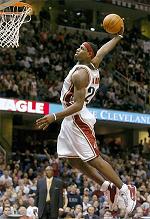
According to ESPN's Stephen A. Smith, Lebron James has informed the Cavaliers that while he is willing to sign an extension, he will not sign a max contract (5 years, $80 million), which the Cavs prefer. Instead, he is only willing to sign a 4-year extension worth $60 million. Considering that NBA contracts are guaranteed, you might wonder why he wouldn't want to maximize his earnings and take as much money as is on the table? It's because of this:
With the NBA's collective bargaining agreement set to expire at the end of the 2010-11 season, James could be positioning himself for an even bigger payday as a free agent when the cap goes up. Under a new agreement, James and other big stars could be in line for deals in the neighborhood of six years and up to $150 million.
James' age may be a factor here as well. Incredibly, he's still just 21 years-old. And when his 4-year extension expires, it will be the summer of 2011 and he will be 26 years-old. It would seem that he would be better positioned for the $150 million, 6-year contract at that point than if he were 27 years-old. But then again, it probably won't matter because he'll likely be the NBA best's player and able to command the max regardless of whether he is 26 or 27.

But here's where age may matter: let's think about James' bargaining position after that $150 million, 6-year contract expires: he would undoubtedly be in a better position for another lucrative contract at age 33 than at 34. So perhaps Lebron and his agent, Leon Rose, are astutely thinking ahead, to a time that may seem very far off (2017 or 2018) but is highly influenced by what they do now, in 2006.

O.J. Mayo and Billy Walker to Challenge NBA Age Restriction?

O.J. Mayo and Billy Walker to Challenge NBA Age Restriction?

ESPN's Chad Ford has an excellent and extensive piece on two amateur players who may put the new NBA age restriction to the test next year: O.J. Mayo (right) and Billy Walker (left), the top two high school seniors in the country. Both players are one year older than a traditional high school senior and, for different reasons, if they decide to drop out of high school and not graduate, they could argue that they "would have graduated" this year. If successful in that argument, they would then be eligible for next year's NBA Draft, since according to the new CBA between the NBA and NBPA, an American amateur player must be at least 19 years-old on December 31 of the year of the NBA Draft (both Mayo and Walker would be in 2007) and that at least one NBA season must have passed from when he graduated from high school, or when his graduating class graduated from high school, and the NBA Draft. If eligible, both would likely be lottery picks, with Mayo possibly going second overall, right after Greg Oden.

Walker has the stronger case for arguing that he "would have graduated in 2006" because the Ohio High School Athletic Association just announced that he should have been a senior this past year. Why? Because a transcript error that resulted from transfering between different schools caused his credits to be counted incorrectly. So according to the Ohio High School Athletic Association (which obviously has no stake in whether Walker can turn pro), Walker has completed four years of high school and four years of high school basketball.

Mayo's claim is based on the fact that he was held back a year early in his schooling, and would have graduated in 2006 but for that, and that he has played high school ball since he was in the 7th grade.

Ford interviews Tim Frank of the NBA and me for the story. Perhaps not surprisingly, we don't agree on whether the players (and especially Walker) should be eligible:
NBA spokesman Tim Frank said that he believes neither player is eligible for the 2007 draft.

"It's when you graduate (or when your class would have graduated), not when your eligibility is up," Frank said via e-mail. "So just because Walker is ineligible [to play high school basketball], he still hasn't graduated, so his class is the 2007 class."

"Mayo being held back eight years ago does not give you a claim to [the 2006 graduating class] as his 'original class.' " Frank said. "He is clearly scheduled to graduate in 2007."

However, sports law expert Michael McCann disagrees.

McCann, a law professor at the Mississippi College School of Law, is the author of the popular Sports Law Blog. He was part of the legal team that represented Ohio State running back Maurice Clarett in his (unsuccessful) legal challenge of the NFL's age restriction.

"Billy Walker should be eligible for the 2007 NBA Draft," McCann told me in an e-mail interview. "An honest interpretation of the CBA dictates that conclusion: His high school class would have graduated, and he would satisfy the requirement that he be at least 19 years old during the calendar year in which the 2007 NBA Draft is held. I believe that the NBA would ultimately recognize the expertise of the Ohio High School Athletic Association (which presumably knows its schools better than the NBA), because if it doesn't, it may unwittingly invite Walker to challenge the age restriction in court, something which the NBA likely wants to avoid."

"Walker's claim for eligibility appears stronger than that for Mayo, although Mayo's situation invites the question of how to measure one's graduating class," McCann said. "Mayo could argue that it should be measured from when he originally began schooling, although the NBA would likely argue that it should be measured from when he began high school. Both arguments are rational, and would likely require the opinion of education experts. The fact that he was playing high school ball as a seventh-grader seems to suggest what his school thought of his class."

We then discussed the implications of either Mayo or Walker bringing a lawsuit, and the applicability of Clarett v. NFL in that lawsuit:
"Unlike when Maurice Clarett challenged the NFL's age eligibility rule, Walker's lawsuit would enjoy empirical data showing that prep-to-pro players have, on average, performed better than any other age group to enter the NBA," said McCann.

"Moreover, while it is commonly assumed that Clarett v. NFL is the definitive case on age restrictions, it isn't. It is the holding of one United States Court of Appeals, and it is unclear how the other 12 United States Courts of Appeal would hold on the matter.

"Even though the NBA's age restriction has been collectively bargained, a good argument can be made that it only affects parties (prep players) outside of the two collective-bargaining units (the NBA and the NBPA), and thus should not enjoy immunity from antitrust laws."
As a separate matter, we also discussed the legal implications of why 19-year old international players are able to more easily enter the NBA Draft than are 19-year old American players. While both groups of players must be at least 19 by December 31 of the year of the draft, the international players do not have a one-year waiting period after high school.

"Should a litigation occur, a court would likely wonder why there exists a more restrictive rule for American amateur players than foreign players, and should it apply antitrust law, a court would likely compare the respective NBA performances of those two groups," McCann said.

This will be a very interesting to story to watch. Ford's article also states that while both Mayo and Walker presently intend to attend college, they would rather go to the NBA directly if possible. The article addresses other topics as well, and is well worth a read (and I strongly recommend ESPN Insider if you don't yet subscribe, especially since you also get ESPN The Magazine).

On three separate notes: 1) thanks to Michael Ryan of Bearcat News for his excellent insight earlier in the day; 2) thanks to Jeff Clark of the highly-addictive Celtics Blog, who wrote a nice posting about the ESPN article on the equally-highly-addictive True Hoop; and 3) since the ESPN article is bringing us a large number of new visitors today, welcome to our blog!

Steroids in Golf?

Steroids in Golf?

By now you are probably tired of reading and hearing about the Bonds indictment and his possible suspension by MLB. But you might not have read or heard about the latest in the "war on steroids": Testing for steroid use has officially begun within the sport of golf ("Golf Tournament Doing Drug Testing"). According to the press release, testing will be administered at the World Amateur Team championship in South Africa at the end of October. What's amazing is that the tournament directors don't even think at the moment that there is much use of performance-enhancing drugs in the sport. They support drug testing in golf "to put the sport into line with the World Anti-Doping Agency's code governing all sports, and to stop performance-enhancing substances from creeping into the game."

Will somebody please STOP THE MADNESS! First and foremost, why test for steroids when there is no evidence whatsoever of any steroid use in the game of golf? Secondly, why would they think that such use would "creep" into the game? Are they afraid that golfers are going to start bulking up in order to give them more distance on their drives? Is "muscle recovery time" a big issue among golfers these days? Basically, it's complete speculation!

I came across an interesting article on this subject written by Matthew Rudy of Golf Digest ("Steroids: How real a threat?"). Rudy notes that no professional tour has specific language in its rules prohibiting performance enhancing substances. The PGA and LPGA tours' professional conduct rules prohibit players from using or selling illegal substances, but neither tour has a testing procedure in place to detect any kind of illegal drug, recreational or otherwise. PGA Tour commissioner Tim Finchem says the tour would not hesitate to incorporate a random drug-testing program IF it had evidence of a pattern of use by players:
"I don't think it is naive to think our players follow the rules. Maybe there are doctors who would say that steroids would help a player hit a golf ball farther. We could debate that, and we could debate that the side effects might hurt a player other ways. I don't go there. We have a rule, and we expect players to follow it. If we have credible evidence to think that a player was taking them, we would consider taking other measures. The speculation about steroids in golf isn't surprising. There is so much focus on steroids in other sports. There's an influx of more athleticism in our sport, and the workout regimens our players are undergoing. And there's a focus on the increased distance players are hitting the ball. That's what it is -- speculation. We rely on our athletes to call the rules on themselves. We have a long tradition of players following the rules, even when some of the rules are odd."
I suppose that if you believe that steroid use would help a hitter drive a baseball farther, then to be consistent you must also believe that steroid use would help a golfer drive a golf ball farther. All this time, I suspected that the reason professional golfers have been driving the ball better over the years was mostly attributed to technological advancements in golf clubs, golf balls, and training equipment.

Tiger, you're next....

The Salivating Army? Shoe Companies that Donate Free Sneakers to Youth Basketball Players

The Salivating Army? Shoe Companies that Donate Free Sneakers to Youth Basketball Players

A couple of weeks ago, we discussed Eli Saslow's excellent piece in the Washington Post on Justin Jenifer, the 10-year old basketball phenom who is already being aggressively recruited by shoe companies. This theme of marketers' exploitation of kid athletes resonates again in Mark Alesia's excellent piece in the Indianapolis Star on shoe companies "donating" free sneakers to youth basketball teams that often feature elite players. Interestingly, the schools receiving these sneakers may be violating Title IX, since only the boys' teams tend to get the donations, while the girls' teams do not. As a result, the boys get free sneakers while the girls end up paying a lot of money for the female version of the same shoes.

I think there are two stories going on here.

1) The Gender Equity Story: the obvious, but still important story. Shoe companies supplying sneakers to boys but not girls is probably a wide-spread phenomenon, and is probably apparent in every state. The disparity in treatment probably comprises a violation of Title IX, which takes a fairly inclusive approach to measuring equal athletic opportunity students of both sexes. In fact, Title IX expressly instructs the U.S. Department of Education's Office for Civil Rights to ensure that there is "equivalent treatment, benefits, and opportunities" in equipment and supplies (among other things). This is the kind of story that got Title IX passed in the first place, and one that further validates its existence.

2) The Sneaker Marketing Story: the more interesting story, I think, because it's subtler and yet potentially far more significant. Consider recent comments by Susan Linn, co-founder of the Campaign for Commercial Free Childhood, told to Julie Sabatier of the New Standard:
"Essentially, it's a way to promote brand loyalty. It makes the corporations look as though they're doing a positive thing. It looks like corporate social responsibility, but in reality, its marketing."
In a way, Linn's comments remind me of a complaint against the tobacco industry and their public service advertisements: those PSAs seem to provide a forum for companies with dubious histories to rectify their image, which turn may help their sales (and thus achieve the opposite of what the PSAs were ostensibly designed to achieve). In a recent Wisconsin Law Review article, I outlined a similar idea in regards to fast food companies promoting "eat well" campaigns, while simultaneously promoting the consumption of Big Macs and Happy Meals etc.

It would be interesting to hear what these shoe companies have to say about their donations, but they have declined comment. I imagine that they have concluded that the value of the brand loyalty they are establishing with boys is worth more than the cost of the donated sneakers, while for girls, they have reached the opposite conclusion: the value of establishing that type of brand loyalty is less than the cost of donations.

Economically-sensible, perhaps, but socially desirable?

Sign of the Apocalypse? Bill Belichick's Alleged Affair and The Boston Herald's Front Page

Sign of the Apocalypse? Bill Belichick's Alleged Affair and The Boston Herald's Front Page

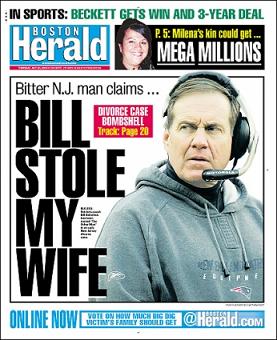
It might seem peculiar for someone who contributes to a sports law blog to question a major regional daily devoting nearly its entire front page to a sports and the law issue. But I ask that you to take a look at the front page of yesterday's Boston Herald:

Yes, Patriots coach Bill Belichick has been named as the dreaded "other man" in a messy New Jersey divorce case involving Sharon Shenocca, who worked as a receptionist for the Giants while Belichick was the team's defensive coordinator. According to Vincent Shenocca, his wife and Belichick have had a long-term extra-marital relationship, with Belichick buying her many gifts, including "expensive clothing, pocketbooks, watches, a treadmill and maid service” and he also allegedly flew her to be with him at Super Bowl XXXVIII, which the Patriots won. Vincent asserts that he has pleaded with Sharon to break-up with Bill (who separated from his wife Debbie last year), but she won't. So now Vincent wants to divorce Sharon, who might soon be spending more time with Bill.

I'm not sure that the late and great Aaron Spelling could have scripted a better story. And it's so interesting because it mixes a hugely successful sports figure and a soap opera-style scandal. I know read the story--which was a Herald scoop--with great interest (I am a lifelong Patriots fan after-all).

But did this story warrant nearly the entire front page, especially at a time when there's a major crisis occurring in the Middle East with many people dying and, more locally, Boston is embroiled in the Big Dig Disaster? Even if the Boston Herald believes that its readers want to read this story, and even if the paper is a tabloid daily, did it have a journalistic duty to treat its editorial decisions with more gravity? And as you can see, the paper even used the top of the same front page to tell readers about Josh Beckett's contract extension!

So is the Herald's front page a sign that sports now attract too much attention? A critic might say no--readers want a break from all of the bad news going on (although a couple's divorce is also bad news, if not quite so terrible), and if they want to read about more depressing things, they can go buy a Boston Globe, turn on a TV, or go on the Internet. What do you think?

World Poker Tour Target of Antitrust Case

World Poker Tour Target of Antitrust Case

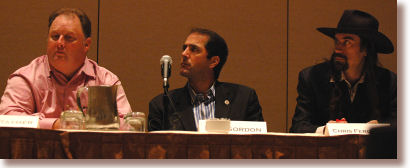
With the World Series of Poker underway in Las Vegas, it's fitting that Dewey Ballantine attorney Jeffrey Kessler chose this month to launch an antitrust case against the World Poker Tour on behalf of champion players including Chris Ferguson and Howard Lederer. The AP's story is here, and the Poker Prof comments here.

The plaintiffs
argue that WPT Enterprises Inc. made them waive lucrative rights to use their images and names to promote products and video games before they could enter WPT tournaments. . . . [T]he suit accuses WPT Enterprises of "price fixing" and "group boycotts" by colluding with 12 member casinos to prevent players from entering tournaments unless they forfeit their rights.
Kessler, according to his firm's web site, "one of the most prominent sports lawyers in the country," brings significant professional sports antitrust experience to the case. And the sports law comparision is obvious, as Kessler emphasized:
Kessler said he has tried similar suits that have changed the way major sports businesses run, including the NBA and NFL.

"Imagine if they were to have said to John Elway in the NFL, 'Well we should just be able to use your image for any product or service that we want,'" Kessler said. "No professional sport has been able to get away with that and the same will be true with respect to the World Poker Tour."


Basketball Player Sues Yearbook After He's Indecently Exposed

A New Jersey high school basketball player has sued his school district and the editors of his high school yearbook after a yearbook photo appeared in which portions of his genitals were visible. The New Jersey Law Journal has the story:
Tyler Bennett of Colts Neck claims he suffered emotional distress because his genitals were partly visible in a basketball game picture in his 2001 school yearbook.

The suit says Colts Neck High School authorities acted slowly to suppress the yearbook, worsening the distress Bennett suffered as a senior the next year.

And there's a novel issue: Does the publisher of such a picture violate child pornography laws if publication was inadvertent?

So far, the answer to that question has been no. Indeed, the whole litigation has been a dud for the plaintiff. In 2005, a trial judge cited Bennett's lack of evidence of psychological harm and found no basis for a suit under the Tort Claims Act. On June 23, an appeals court affirmed the dismissal.

Undeterred, plaintiff’s attorney Steven Kessel notified his adversaries this month that he will seek review by the state Supreme Court. He is drafting an appeal that raises the issues anew and will set off a new round of defense briefs in the case, Bennett v. Board of Education, Freehold Regional High School District, Mon-L-4700-03.
High school athletes – like all athletes – assume certain risks when they take the court. Had Tyler Bennett been elbowed during practice, he would not have been able to recover (absent unusual circumstances). This case poses some interesting questions about the degree to which athletes assume the risk of other likely results of participating in high school sports. Here, does an athlete assume the risk that his private areas may be visible, and possibly be recorded and published by student journalists?

The most damning piece of evidence for the plaintiff?
The offending photograph, taken from a low angle, showed Bennett shooting a basket on a day he wore boxer shorts instead of an athletic supporter . . .
Hat tip to my colleague Howard Friedman for the link.

Phil Kessel: Getting Help from a Family Friend or Representation by an Agent?

Phil Kessel: Getting Help from a Family Friend or Representation by an Agent?

But you say he's just a friend.
--Biz Marke, from his sublime 1988 song "Just a Friend"

It's not too often when I can invoke lyrics by the great artist, Biz Markie, but they come to mind when reading about the Boston Bruins' contract negotiations with first round draft pick Phil Kessel, a rising sophomore at the University of Minnesota, and Kessel's "family advisor," Wade Arnott.

Here's the deal: although Wade Arnott is an NHLPA certified agent--and a well-respected one at that--who works for the sports agency Newport Sports Management, he is not acting as Kessel's agent in Kessel's contract negotiations with the Bruins.

Rather, he's acting as Kessel's "family advisor" or "family friend."

What's the difference? Well, possibly two things: Arnott is not being compensated in any way by Kessel, and there is no contractual relationship between the two. But those may only be illusory distinctions: even if Arnott were Kessel's agent, his compensation would likely be derived by a 2% or 3% cut of Kessel's contract, and because it's expected that Kessel will sign with Arnott as a client right before he signs with the Bruins as an employee, Arnott will still get that cut as a friend. Moreover, Kessel, like any player, can likely drop Arnott at any time, for any reason, with or without a contractual relationship (meaning the existence of a contractual relationship may not be meaningful).

So why the difference? By Arnott being labeled a "family advisor" or "family friend," Kessel can maintain his NCAA eligibility. So if Kessel's contract talks with the Bruins were to fail, he can return to the University of Minnesota and play there in the 2006-07 season. In contrast, if Kessel were to formally sign with Arnott, NCAA rules dictate that he would immediately forfeit his collegiate eligibility.

While I understand that this arrangement bolsters the negotiating power of amateur players, is the NCAA really fooling anyone by engaging in name semantics? If they are really worried about the undue influence of agents (a legitimate concern) why are they letting the very same agents get around the rules by acting as "family friends"?

More on "Donated" Sneakers, Brand Loyalty, and Title IX

More on "Donated" Sneakers, Brand Loyalty, and Title IX

In the last couple of weeks, we've discussed how shoe companies are arguably manipulating children by "donating" high-priced sneakers to young basketball players as a way of building brand loyalty, and also how by only donating to boys, they may be inducing schools to violate Title IX (see The Salivating Army and Justin Jenifer post).

There are two more great stories on this topic. One is by Rachel Bachman of the Portland Oregonian ("Shoe deals sidestep rules on equality in schools," June 12, 2006, archived). She details possible Title IX infractions and interviews a number of key people involved, including a surprisingly-forthcoming Tony Dorado, Nike's national manager for high school basketball, and Tulsa Law professor Ray Yasser, who has handled over 40 Title IX cases:
Hoping to curry favor and associate themselves with budding sports stars, usually in basketball, companies give shoes and gear to high school teams. Nike, Adidas and Reebok sponsor about 300 high school basketball teams nationwide, a widely accepted practice that merely rewards the best programs, some coaches say.

But experts say that when a school accepts free goods for a team of one gender while providing nothing for a team of the other gender, it is breaking the law. Title IX bans sex discrimination in
schools, whether in the classroom or sports. And although most high school officials grasp the need to provide equal opportunities and facilities, the issue of private donations to sports teams remains misunderstood.

"The school has an obligation under Title IX to provide equal benefit,"said Linda Carpenter, professor emerita at Brooklyn College and co-author of a book on Title IX. "So if the guys' team receives benefit from Nike in the form of shoes, bags, etc., then an equal proportion of the women's program needs to receive similar benefit."

At many schools, that is not happening. About 75 percent of the high school teams sponsored by Nike, the national leader in basketball-shoe sales, are boys teams, said Tony Dorado, Nike's national manager for high school basketball. That figure is driven by a market in which boys buy far more basketball merchandise than girls do, Dorado said . . .


Nike's goal in sponsoring high school teams is to identify with the nation's best programs and players and boost sales of gear to schools' nonsponsored teams, Dorado said. The idea is to build brand loyalty, and the jackpot is when a player on a sponsored team reaches the NBA, signs an endorsement contract and helps the company sell millions of shoes.

Ray Yasser, a law professor at the University of Tulsa, said he has worked with the Schiller Law Firm of Cookeville, Tenn., to handle about 40 Title IX cases. All of them have settled favorably for the plaintiffs, Yasser said. The issue of schools accepting shoe-company donations for only one gender has come up before, Yasser said, but has not become public because none of his cases went to trial. "The irony of the shoe thing is, every time we've done it, we've raised it, all I had to do is ask the shoe companies," Yasser said. "And if they're giving shoes to the boys, they'll give them to the girls. They're further ahead of the curve than some of the administrators are."
Here's another great piece: Bob Hohler's stunning exposé in the Boston Globe on independent coach/recruiter Thomas J. ``TJ" Gassnola, whose tactics in building "brand loyalty" have earned him a notorious and feared reputation ("$neaker War," July 23, 2006). Check out how Hohler's piece--the first of an of an excellent three-part series on youth basketball and marketing--begins:
A brazen foot soldier in a multibillion-dollar war between sneaker makers for the soles of America's youth, Thomas J. ``TJ" Gassnola has peddled basketball dreams to inner-city adolescents across New England despite a lengthy criminal history and prodigious legacy of financial delinquency.

The face of youth basketball in the region for Adidas, Gassnola is a free-wheeling recruiter whose tactics often have clashed with rules set by the National Collegiate Athletic Association to protect amateur athletes who aspire to careers in college sports. Some of his practices underscore the inability of the NCAA and other watchdog agencies to adequately police abuses in summer youth basketball.

A Globe investigation of the sneaker industry's influence on youth basketball in New England found that Gassnola has handed cash to members of his Adidas-sponsored summer travel teams for expenses unrelated to basketball. Several parents of elite players said the Springfield-based recruiter offered them free airfare or Adidas merchandise while pursuing their sons, and another parent said he interpreted Gassnola's sales pitch to mean the recruiter would provide his son improper financial aid. NCAA rules bar amateur players from receiving anything but ``actual and necessary travel, room and board, and apparel and equipment for competition and practice."

The Globe also witnessed Gassnola drive his teenage players in several states, even though his Massachusetts driver's license has been revoked or suspended 24 times and was not valid from 1993 until last month.

It seems like there's a movement afoot to clean up youth basketball, with the first step being exposing what's really going on. Then again, did Hoop Dreams (one of my favorite two or three films of all time) generate any reforms?

Harold Reynolds Fired: Is Sexual Harassment Situational or Dispositional?

Harold Reynolds Fired: Is Sexual Harassment Situational or Dispositional?

Neil Best of Newsday writes about Harold Reynolds' surprising firing from ESPN--allegedly because of a sexual harassment complaint filed against him--and in the process, suggests that sexual harassment is a significant problem at the network:
Harold Reynolds, one of ESPN's most visible analysts and a longtime panelist on "Baseball Tonight," has left the network in the wake of one or more incidents of sexual harassment.

Three people who work at ESPN and were familiar with the case said the cause was a pattern of sexual harassment, apparently culminating in a recent incident involving one of the network's young production assistants . . .

Harassment charges are nothing new at ESPN, which operates out of a sprawling "campus" in relatively isolated Bristol, Conn., and employs many production assistants in their early 20s. The network has an extensive program of education and sensitivity regarding gender issues and an elaborate system for pursuing claims of sexual harassment.

Keith Olbermann of MSNBC, a former ESPN host, told The New York Observer in 2004 he had testified in "three or four major cases at ESPN."

Among the prominent ESPN personalities accused of improper behavior in the past is Mike Tirico, who will debut as the play-by-play man for "Monday Night Football" in the coming season. He was suspended by ESPN in 1992 for what were reported at the time to be allegations of sexual harassment. Another host, Jason Jackson, was fired in 2002, reportedly for harassment.
If these accusations are a true--a big "if" since we've seen no evidence in a court of law--what do they suggest about the power of workplace "situation" on the behavior of employees? In other words, to what extent do the workplace circumstances in which ESPN anchors find themselves--being famous ex-jocks or sports guys around young women in a college campus-style setting--cause or encourage some of them to do really stupid things? Has ESPN created a workplace enviroment akin to a male locker room, or is this really about the individual wrongdoers and not about their workplace?

Excitement of USA Basketball.

Excitement of USA Basketball.

First, I want to thank Rick Karcher and Michael McCann for inviting me to be a guest. After several days of trying to log on, I finally listened to and followed Michael's instructions and was able (hopefully) to make a post. While its tempting to post a comment on the on-going issues concerning anti-doping, it seems the resurrection of the USA Basketball team recently is a new, fresh topic for discussion.

Depending on your age, you probably recall the first "Dream Team" that went to Barcelona and walked through the 1992 Olympics on its way to the gold medal. Once the U.S. got comfortable that these "professional" NBAers could play on the Olympic team, the only remaining issue was how to allow the athletes wear uniforms, shoes, and other gear that was not made by the compaines that were sponsoring them.

Over the past few years, a combination of the world players catching up to the our talent and what appears to be us taking the Olympic and World Championships victories for granted has resulted in poor (in comparision) results. (what other factors contributed to our decline?)

Now, with the recent headlines, it looks as if USA Basketball has made a firm commitment to obtain a cohesive team put together well in advance of the Olympics under a Coach (Coach K) who will focus on the game as played in international competition.

Whole lot of legal issues such as player likeness, injuries, sponsors, drug testing, etc....any thoughts?

(For those that do not know, those athletes who are not normally subject to drug testing standards set out by WADA (such as those that fall under a CBA) are subject to the WADA rules prior to the Olympics and World Championship games including the USA Basketball team currently put together).

Ex-NBAer Mashburn sued for golf injury

Ex-NBAer Mashburn sued for golf injury


One-time Miami Heat basketball player Jamal Mashburn (who retired from basketball in March after he was waived by the 76ers), has been sued by a Florida man who claims Mashburn failed to shout “fore” or provide any warning before hitting a golf ball in the man’s direction. The plaintiff claims to have suffered serious injury.

Mashburn developed an interest in golf at the University of Kentucky. At least that’s what he told the Charlotte Hornets, as reported in a puff piece “Getting to know . . . Jamal Mashburn”:
"I'm a big-time golfer," Mashburn said in reaction to what he likes to do off the court. "I started playing when I was in college. They turned me on to that at the University of Kentucky."

"It was either that or horses," Mashburn continues, grinning as he recollects. "I didn't get into horses, so I got into golf." Golf is just one of his hobbies.
The lawsuit gets coverage here, here and here. The basics:
Jerome Crance was hospitalized on three separate occasions after the ball struck him in the eye, his lawyer Dennis Koltun said Tuesday.

The lawsuit was filed Monday in Miami-Dade Circuit Court and seeks an excess of $15,000 in damages.

Crance and Mashburn, who retired from the NBA after an injury last year, were both playing golf at the upscale LaGorce Country Club in March 2005. Crance was teeing off on the 17th hole when Mashburn hit a shot off the 18th hole that struck him in the eye, the lawsuit said.

Mashburn didn't yell "fore" when he hit the stray ball and failed "to give any warning whatsoever," the lawsuit said.

Koltun said his client suffered serious injuries after the incident.

"He's permanently lost vision in one eye because of a detached retina," Koltun said.
The Hawai’i Supreme Court rejected a similar case earlier this year, as I discussed in this post. In Florida, the issue of a golfer’s ability to recover from a co-participant was squarely addressed by an appellate court over thirty years ago. In Rindley v. Goldberg, 297 So.2d 140 (Fla. App. 1974), a golfer sued after she was hit by a ball struck by another member of her foursome. The court was able to resolve the dispute in just three paragraphs: “Viewing the above facts in the light most favorable to the party moved against, we conclude therefrom that plaintiff’s injury was a result of the certain obvious and ordinary risks of the sport of golfing which she assumed as a member of a golfing foursome with full knowledge of the normal dangers of participating therein.” Perhaps the plaintiff is hoping Mashburn will offer him some money as a nuisance settlement, since the Rindley case would seem to doom his litigation.

The plaintiff might find some solace in a somewhat more recent case in which a golfer (at a Par 3 course) hit a ball which ricocheted back and hit him in the eye. In that case, Potter v. Green Meadows, Par 3, 510 So.2d 1225 (Fla. App. 1987), while denying defendant summary judgment on an express assumption of risk theory, the court implied that it might not extend the contact sports rule on assumption of risk to golf ("There is no evidence of an express covenant not to sue in this case and golf is not generally recognized as a "contact sport.'").

I wonder if Mashburn is wishing he'd taken up horses at UK instead...

Emerson completes Real switch

Emerson completes Real switch

MADRID, (AFP) - Brazil midfielder Emerson was officially unveiled as a Real Madrid player on Wednesday.

Just a day after his former Juventus teammate Fabio Cannavaro finalised his move to the Spanish giants, Emerson signed a three-year deal.

"I am very happy to be here," said Emerson. "It is something I had been thinking about for several years and now it has happened.

"Now I am playing for a team as important as Real Madrid and I hope to achieve great things, as happened at my previous clubs."

The 30-year-old, who spent two seasons at Juventus following spells at Roma and Bayer Leverkusen, was greeted by around a thousand cheering fans as he pulled on the famous white shirt for the first time.

Emerson not only joins up with Cannavaro but also former Juve boss Fabio Capello who also left the Turin giants in the wake of the Italian match-fixing scandal that saw Juventus relegated to the second division.

"He is a very valuable player who benefits the team, who sacrifices himself for the good of the team," said Real president Ramon Calderon. "He is a player that everyone appreciates and values."

Nedved staying with relegated Juventus

Nedved staying with relegated Juventus

PRAGUE, (AFP) - Czech international Pavel Nedved has pledged his future to scandal-plagued Italian giants Juventus, vowing to stay with the club next season despite their relegation to Serie B.

The 34-year-old midfield star has decided against following Juve team-mates Emerson, Fabio Cannavaro, Lilian Thuram and Gianluca Zambrotta out of the Stadio delle Alpi and is preparing for life in the second division.

"Pavel will be a Juventus player next season," Nedved's agent David Nehoda was quoted as saying by the Czech news agency CTK.

Several top European clubs had expressed an interest in signing Nedved, the 2003 European Footballer of the Year and recognised as one of the most skilful midfielders in the world.

Among those believed to be chasing Nedved were French side Lyon and English Premiership outfit Tottenham.

Marseille boss to hold clear the air talks with unsettled Ribery

Marseille boss to hold clear the air talks with unsettled Ribery

MARSEILLE, (AFP) - Marseille boss Pape Diouf vowed Wednesday to hold clear-the-air talks with unsettled star Franck Ribery in order to secure the French international's future at the club.

Ribery has been the subject of intense transfer speculation since sparkling for France during their run to the World Cup final earlier this month, with Arsenal, Manchester United, Bayern Munich and Lyon all chasing his signature.

The transfer talk has angered Marseille president Diouf however, who has vowed to hang on to Ribery for at least one more season.

The talented 23-year-old is currently contracted to Marseille until 2010 after signing a contract extension in March but was quoted as saying in June that he favoured a move to Lyon.

Diouf wants to clear up the situation before the start of the new French season next month, and plans to meet Ribery on Saturday for talks.

"Because of certain events that have happened in the close season, I will meet with him to clear up the misunderstandings, if indeed there are any misunderstandings," Diouf said.

Diouf meanwhile revealed Marseille were interested in signing former Arsenal defender Sol Campbell, who parted company with the Gunners at the end of last season. "He is someone we are interested in," said Diouf.

"But at this stage it is far too early to talk about him being a Marseille player next season."

Thuram's kids delighted with Barca move

Thuram's kids delighted with Barca move

Liliam Thuram is pleased to move to Barcelona.


BARCELONA, (AFP) - While France defender Liliam Thuram is overjoyed with his move from Juventus to Barcelona, it is his children who are most pleased, the 34-year-old said Wednesday.

That is because they will now get to watch their heroes Ronaldinho and Samuel Eto'o at first hand week in, week out.

"They are happy I am playing for Barcelona because they will be able to watch Ronaldinho and Eto'o," Thuram told the Barcelona website.

It will not be the first time the children have seen the stars, having attended last season's Champions League final which Barcelona won 2-1 against Arsenal.

"I went to see the Champions League final with my children and I really enjoyed watching Barca play - they are a great team," added Thuram.

Thuram has signed a two-year deal with the Spanish and European champions having left Juve in the wake of the Italian giants' relegation over a match-fixing scandal.

"I am very happy to join Barcelona because for a footballer, there is no-one better than Barca, they are one of the best teams in the world.

"I will do everything, like at the beginning of my career, to realise the highest expectations."

Thuram has had a high opinion of the Catalan club ever since his first competitive brush with Barca as a player for Monaco in the 1993-94 Champions League.

"I was a kid. I was 20 or 21 years old. The Barca coach was (Johan) Cruyff and I had to mark (Brazilian legend) Romario," said the Guadeloupe-born centre-back.

"I also remember (Michael) Laudrup, (Pep) Guardiola and (Ronald) Koeman, and at the end of the match I said to myself that we were not playing the same game. They were playing football and me, I was playing another sport."

Fan fury as Man Utd thump Celtic in pre-season friendly

Fan fury as Man Utd thump Celtic in pre-season friendly

GLASGOW, (AFP) - Celtic fans were left fuming after watching Gordon Strachan's side get torn apart 3-0 by an inexperienced Manchester United line-up in a pre-season friendly here Wednesday.

One fan's fury got the better of him in the final moments when he raced on to the pitch at Parkhead to register his disgust shortly after Paul Scholes had bagged his second of the night on 84 minutes.

The result will alarm Celtic boss Strachan as his side prepare to begin the defence of their Scottish Premier League title against Kilmarnock at the weekend.

United were in control from the outset, defender Jonny Evans firing the Red Devils into the lead from close range in the eighth minute before Scholes netted twice in the second half.

Strachan left Stilian Petrov out of the squad after a new bid from Portsmouth for the unsettled midfielder was rejected, and started a number of squad players including Mo Camara, Alan Thompson and Paul Lawson.

But the Bhoys were no match for a United side boasting just a handful of first-team regulars, with a fit-again Scholes and Darren Fletcher running the show from central midfield.

Scholes, who missed five months of last season with an eye problem that affected his vision, was in superb form throughout.

Paul Scholes celebrates his goal
Paul Scholes celebrates his goal with Lee Martin and Darren Fletcher. (Action Images / Lee Smith)
Published : July 27, 2006

Liverpool complete Pennant swoop

Liverpool complete Pennant swoop

LIVERPOOL, England, (AFP) - Liverpool completed the signing of Birmingham winger Jermaine Pennant for a reported six million pounds (11.1million dollars) on Wednesday.

Pennant, 23, agreed a four-year contract and will link-up with his new team-mates on the English Premiership club's pre-season tour to Switzerland.

Liverpool manager Rafa Benitez moved for Pennant after having several offers rejected for Sevilla's Brazilian star Daniel Alves.

The former Arsenal player becomes Benitez's fifth summer signing following the arrivals of Craig Bellamy, Fabio Aurelio, Gabriel Paletta and Mark Gonzalez.

Pennant, who became the most expensive teenager in British football when he joined Arsenal from Notts County for two million pounds in 1999, believes the move to his boyhood idols can help him break into the England team.

He told Liverpool's website: "I've dreamt about this since I was a little boy so to actually be here and to be able to wear a Liverpool shirt and play at Anfield is a dream come true.

"This is the only club I would have wanted to sign for. There's always a doubt in your mind as to whether or not it will happen because you don't know if the clubs will agree a transfer fee but I just stayed positive and believed it would happen for me.

"Moving to Liverpool will only help me (with his England ambitions). Playing with players of the quality at this club can only be good for my career. I couldn't be more excited."

Benitez is also reported to be making another attempt to sign Holland striker Dirk Kuyt.

Feyenoord have already turned down two Liverpool offers for Kuyt, believed to have involved cash plus defender Jan Kromkamp and goalkeeper Jerzy Dudek, but Benitez is ready to make an improved bid.

Greek striker Lazaros Christodoulopoulos, 20, is also set to sign from PAOK Salonika after impressing during a trial at Anfield, according to reports in Greece.

Van Nistelrooy due to sign on Real dotted line

Van Nistelrooy due to sign on Real dotted line

MADRID, (AFP) - Manchester United's Dutch international Ruud van Nistelrooy was Tuesday due to finalise his 14-million-euro (18 million dollars) transfer to Real Madrid, Marca sports daily reported.

"Real Madrid will announce today the transfer of Van Nistelrooy," Marca wrote of the man who would be Real's first signing of the summer.

"An agreement has been reached for 14 million euros," Marca added, saying the Spanish side's sporting director Pedja Mijatovic would go to England to tie up the details.

"It will be the first transfer of the Fabio Capello era."

Capello is coaching the nine-times European champions for a second time after leaving Juventus.

Van Nistelrooy, just turned 30, lost his place at Old Trafford in the final quarter of the season as he fell out with manager Sir Alex Ferguson and was also a spectator as Holland went out of the World Cup to Portugal.

But Real see a man, who hit 95 goals in 150 appearances for the Reds in five years after signing from PSV Eindhoven, as key to bringing them their first silverware since 2003.

Published : July 19, 2006

Friday, July 14, 2006

Germany 2006: 32 teams, 32 stories

Germany 2006 will no doubt be remembered as the fans’ FIFA World Cup™. With millions of people attending public screenings of the event, the atmosphere in the host country was incredible, as people from all over the world took the official motto ‘A time to make friends’ to heart.

On the pitch, 32 teams battled it out for football’s ultimate prize. Some bowed out after just three games while France fell at the final hurdle as Italy claimed the crown of world champions, a description that will be used against their name for the next four years. Here, FIFAworldcup.com reviews the performance of each individual team, listed in order of how far they got.

Relive the 2006 FIFA World Cup

Winners:

Italy
The Azzurri won the FIFA World Cup for the fourth time after holding their nerves in a dramatic penalty shoot-out. For their performances in the group stages, Round of 16, quarter-finals and semis, football fans all over the world would agree that Marcello Lippi's side were worthy winners of the competition.

Runners-up:

France
Inspired by Zinedine Zidane, until his dramatic sending-off in the Final, Les Bleus surprised everyone to reach the showdown in Berlin on 9 July. Although they looked shaky in the group stage, it was in the knockout rounds that they really came into their own, defeating Spain, Brazil and Portugal with relative ease.

Third place:

Germany
The highest scorers at the tournament captured the imagination of the public with a combination of fine football and a never-say-die attitude.

Fourth place:

Portugal
Luiz Felipe Scolari’s outfit were arguably the surprise package of Germany 2006, overcoming Mexico, the Netherlands and England en route to the semi-finals.

Quarter-finalists:

Argentina
After some great performances in the group stages and a victory over Mexico in the Round of 16, the Albiceleste were unlucky to lose to the hosts in a dramatic shoot-out.
Brazil
The world champions’ attempt to secure their sixth FIFA World Cup success ended after a lacklustre showing against France. A tournament to forget for the Seleção.
England
Unlucky with injuries, unlucky from the spot. Once again, penalties proved to be the undoing of England, who failed to live up to their high expectations at this event.
Ukraine
Coached by Oleg Blokhin, the FIFA World Cup first-timers did extremely well in reaching the last eight, but found Italy too tough an opponent in Hamburg.

Round of 16:

Australia
Not expected to get past a group which included Brazil, Croatia and Japan, Dutch coach Guus Hiddink masterminded a magnificent showing by the Socceroos.
Ecuador
Before the tournament began, it was claimed that the South Americans could not play well away from their home country. La Tricolor proved their doubters wrong.
Ghana
As the only side from the continent to qualify for the Round of 16, Ghana were rightly described as the ‘Pride of Africa’. Victories over the USA and the Czech Republic cemented this claim.
Mexico
El Tri will be disappointed with their exit in the Round of 16 but the match against Argentina - which they lost 2-1 after extra time - will surely be remembered as one of the tournament’s best.
Netherlands
After qualifying from what was thought to be the tournament’s toughest group, Marco van Basten’s men came up short against a well-organised Portugal side.
Spain
Tipped by many to go far in the competition after disposing of Ukraine, Tunisia and Saudi Arabia with relative ease at the group stages, Spain fell at the very next hurdle.
Sweden
Conceding two early goals in the first 12 minutes to Germany effectively ended the Swedes' hopes of progressing to the quarter-finals.
Switzerland
The winners of Group G failed to convert any of their three penalties against Ukraine to see them exit the competition with an unwanted new FIFA World Cup record.

Group Stages

Angola
While not altogether unexpected, Angola's first-round elimination was down to a combination of inexperience and tactical limitations.
Costa Rica
Costa Rica were hoping for big things in Germany, but the team which was considered to be one of the best in the country’s history, failed to get past the group stage.
Côte d'Ivoire
The Elephants came with a lot of promise and although they fell at the first hurdle, they won many friends and admirers in their all-too-brief visit to Germany.
Croatia
Back home many thought that a clash with Italy in the Round of 16 was the team's destiny. However, failure to take chances put paid to Croatia's hopes.
Czech Republic
They entered the FIFA World Cup as one of the highest-ranked teams and got off to an impressive start. But injuries struck their forwards and the journey home came all too soon for the Czech Republic.
Iran
Defeats by Mexico and Portugal in their opening games left Iran with no chance of advancing. The subsequent point claimed against Angola was no consolation at all.
Japan
Two goals and a solitary point were all Japan had to show for their efforts at Germany 2006, the tournament which brought to an end Zico’s reign as coach.
Korea Republic
Victory against Togo gave the Taeguk Warriors their first FIFA World Cup success on European soil, but it was not enough to book the team a place in the Round of 16.
Paraguay
Paraguay returned home having picked up just three points from their three Group B encounters. Their hopes were ended by narrow defeats in their opening two matches.
Poland
Poland and their fans are unlikely to harbour fond memories of Germany 2006, but a 2-1 win over Costa Rica in their final match did provide some consolation.
Saudi Arabia
Saudi Arabia for their fourth consecutive appearance at the FIFA World Cup finals, and once again Sami Al Jaber weighed in with a goal.
Serbia and Montenegro
The team that only conceded one goal in qualifying to finish ahead of Spain, somehow ended up on the receiving end of ten in as many days in Germany.
Togo
Having suffered three defeats in as many games, Togo bade farewell to Germany as the bottom team in Group G, with off-field issues contributing to their downfall.
Trinidad and Tobago
Showing great determination and resolve to make up for their inexperience and lack of resources, T&T will look back on their two weeks in Germany as a success.
Tunisia
Tunisia made history by becoming the first African side to record a win at Argentina 1978. Twenty-eight years on and three campaigns later they have yet to repeat the feat.
USA
They earned only a single point, thanks to a 1-1 draw with Italy, and there is no shortage of things that could have gone better for this US squad.

Germany 2006: The interviews

Michel Platini (FRA), 9 July 2006
I don't think France are the best team in the world, but they are very difficult to beat, and especially so in a Cup competition. Exactly the same goes for Italy, and it's no coincidence that these two sides are in the Final.

Gary Lineker (ENG), 7 July 2006
(Miroslav) Klose has looked sharp, as he did in the previous World Cup. I think he’s a classic poacher, his movement in the box is really good and he is a clinical finisher when he gets the chance. He’s got a terrific record at international level and you can see why. The important thing is he’s taken it into a big tournament where so many others have failed.

Raymond Domenech (FRA), 7 July 2006
Don't go thinking that I’m on some sort of personal revenge mission. I don't look at it like that and I've never held a grudge against anyone. I still think I've done what needed doing, and perhaps the criticism was as well-founded as my own belief in this side.

Lukas Podolski (GER), 7 July 2006
It's just great to win an award like this at the biggest tournament in the world. I want to thank everyone who voted for me and of course the other guys in the squad. My winning the award was all down to the team. Of course, it's not quite as good as winning the whole tournament though.

Alessandro Del Piero (ITA), 3 July 2006
Germany start as favourites (for the semi-final), but if we really play as a team, as we know we can, then we can win. It’s too early to say whether this World Cup has been a success or not for me personally. Let’s wait until it’s all over.

Jorge Valdano (ARG), 3 July 2006
I just think we saw very little of Lionel Messi. Even so, it was enough to realise that he’s a player with something that sets him apart from the rest we’ve seen in Germany. He’s also prepared to go out and take risks, all that in a World Cup where nobody wants to gamble.

Andriy Shevchenko (UKR), 26 June 2006
Qualifying for the finals themselves was very tough, but now we’re enjoying every minute of our time here. Apart from the national team, the domestic league and the country’s youth sides will also benefit from this World Cup. We know that all of Ukraine are supporting us. Being part of a sporting occasion of this magnitude and doing so well at it has helped bring the people together.

Ronaldinho (BRA), 25 June 2006
I’m not performing to the best of my ability right now, but I am improving. We all need to be patient. The World Cup is a marathon not a sprint. I'm playing more centrally and deeper so it means I have less impact in the final third. At Barcelona I can go by one man and have a chance to shoot, but in my position for Brazil beating two or even three players does not automatically mean I have a sight of goal.

Lee Young-Pyo (KOR), 24 June 2006
We might have had too many young players in the team here in Germany, and this can also be a negative thing. Sure, they run hard and give everything they have but they can also lack those things that only come with experience. So for us, I think it was a double-edged sword.

Juan Riquelme (ARG), 23 June 2006
As long as I’m playing I’m happy, whether it be for Argentina or my club. In fact, every time I run out onto a football pitch I feel happy. It’s all I need.”

Rafael Marquez (MEX), 22 June 2006
I had a terrible time of it against Portugal and made a lot of mistakes early on. Then I tried to raise my game, but I lost my concentration. It just wasn’t my day. Now, I have to stay calm. These things happen in football, as no one is perfect. The most important thing is that the team are through to the next round.

Pele (BRA), 22 June 2006
I wouldn’t be upset if (Theo) Walcott became the youngest-ever goalscorer at a FIFA World Cup, as long as Brazil ended up as world champions. Back in 1958, I scored a few goals and Brazil won the Trophy. I wouldn’t like it if he scored and England ended up winning it.

Julio Caceres (PAR), 21 June 2006
We want to apologise to the fans because hopes were very high when we qualified. We really thought we were going to go further than Paraguay have ever gone before, but we’ve ended up making our earliest-ever exit.

Dwight Yorke (TRI), 18 June 2006
My legs don’t go as fast as they used to. I just felt that it would be better to play in midfield than as a centre-forward, although I do know I can still do a job up there. I enjoy passing the ball and creating chances for others in the team, so it’s a good fit.

Pauleta (POR), 16 June 2006
“The favourites are the same as always: Brazil, Italy, Argentina and Germany. As for Portugal, for now we’re just thinking about reaching the Round of 16. However, if we get that far, anything can happen.

Didier Drogba (CIV), 16 June 2006
At the time, the goal (against Argentina) meant nothing to me. It's what I call a ‘meaningless’ goal because it didn't change the outcome. Having said that, it was a historic goal for Ivorian football, as it was our first at the World Cup finals. For that reason I'm delighted. It's important to leave your mark.

Jairzinho (BRA), 13 June 2006
To be honest, I’m very concerned about how Brazil will perorm at this World Cup. I know (Mario) Zagallo and (Carlos Alberto) Parreira well, but I think we’re making it difficult for ourselves to win our sixth title. There are a few players in the starting line-up who are not at their best right now.

Mario Kempes (ARG), 12 June 2006
People say Ronaldo’s overweight, but fat or thin, give him the ball and in four yards he’s gained a yard on you. He’s so quick in the area and one of the most powerful forwards in the game. I expect great things from him. He’s just a few goals away from beating Gerd Muller’s record.

Ronaldo (BRA), 11 June 2006
Individual records have to take a back seat here. My main objective is to win the World Cup. Of course, I’ll be delighted if I do break Müller’s record (as overall top scorer), but it’s not my number one priority.

Horacio Elizondo (ARG), 8 June 2006
Just like the players, the referee tries to envisage the game in his head and imagine the different situations that might arise: a nice, easy game or a hot-tempered one, a penalty or a card or two. Players hope that things happen in a game, whereas your average referees tries to visualise a game without problems. You need to be focused, have no pre-conceived ideas, keep a clear head and believe in your own abilities.

Andoni Zubizarreta (ESP), 4 June 2006
Who are my favourites for the title? Brazil without a doubt. When a team is such clear favourites, though, it’s always difficult to translate that out on the pitch. But they’ve certainly got the most complete team. Having said that, Italy also look to be in really good form.
Italy hold their nerve to claim fourth crown

Italy hold their nerve to claim fourth crown

9 July 2006


THE FINAL DAY REPLAYED: Fabio Cannavaro, a player who has belied his diminutive stature with some giant performances this past month, fittingly closed the 2006 FIFA World Cup™ by holding the biggest prize in football aloft. Fireworks proclaiming a fourth FIFA World Cup for Italy exploded into the black skies above the Olympiastadion as the Azzurri party began, leaving France – and a disconsolate Zinedine Zidane – to their own thoughts.

What an occasion the 18th Final produced with excitement at the start and incredible drama at the end as Zidane, on his farewell to the game he has dignified for so long with his graceful skill, was shown the red card. On it went to a penalty showdown and five unerring Italian spot-kicks delivered them the title of world champions, with David Trezeguet the luckless player to miss. With Fabio Grosso converting, his country edged one Trophy behind Brazil in the pantheon of FIFA World Cup winners.

Zidane will remember this night for as long as he lives. France had promised to repeat their success of 1998 for their retiring captain and only he will know what possessed him when he thrust his forehead into the chest of Marco Materazzi. Zidane had to go, accompanied down the tunnel by the glare of thousands and thousands of flash bulbs and the tears of the legions of French supporters.

“Allez les Blues” they had chorused again and again. The Blues came through all right but it was the blue of Italy that held sway. France were wearing white but what colour they added to the occasion with their stirring comeback after Marcello Lippi’s side had threatened to put a stranglehold on the game.